

Back
ONCDOFT Circular 003-2026 for real estate agencies and agents in Venezuela.
Due diligence

Must real estate agencies in Venezuela register with the ONCDOFT? Circular 003-2026.

For a real estate agency or agent, the first question is likely much simpler: does this apply to my business, and what would I need to do?

By ReliaHouse

12 min read
Last updated:

Registration enters the real estate sector conversation

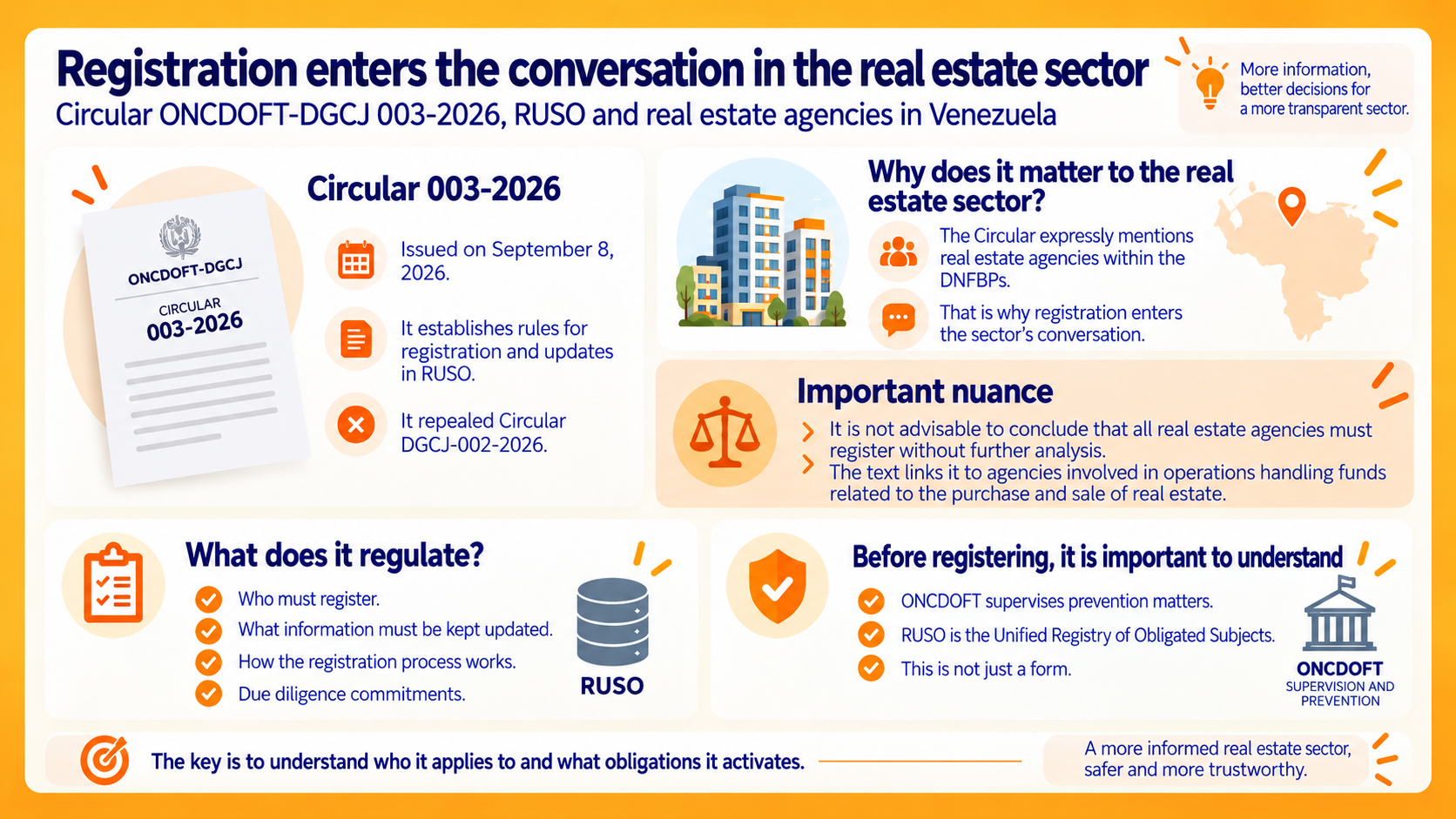
On September 8, 2026, Venezuela’s National Office Against Organized Crime and Terrorist Financing (ONCDOFT) issued Circular ONCDOFT-DGCJ 003-2026. The document establishes rules for the registration and updating of certain parties before the Unified Registry of Obliged Entities (RUSO) and revoked Circular DGCJ-002-2026, which had been issued only a few days earlier, on September 1.

For the real estate sector, the Circular is particularly relevant because it expressly includes real estate agencies among the Designated Non-Financial Businesses and Professions (DNFBPs) covered by its provisions.

There is, however, an important distinction: the document links this inclusion to agencies involved in transactions where there is handling of funds related to the purchase and sale of real estate.

What does this mean?

This means it would be premature to conclude that every real estate agency in Venezuela is automatically required to register.

The Circular itself establishes conditions related to the type of activity being carried out. Later in the document, it also refers to real estate agents considered to be obliged entities when addressing customer due diligence and the determination of the source and destination of clients’ funds.

For that reason, the change should not be understood simply as the introduction of another registration form. The Circular addresses who must register, what information must be kept up to date, and how the registration process works, while also introducing due diligence commitments for those who are considered obliged entities.

Note: This article is for informational purposes and is based on Circular ONCDOFT-DGCJ 003-2026 and publications issued by the Venezuelan Chamber of Real Estate. It does not constitute legal advice and does not determine whether a specific individual or company qualifies as an obliged entity.
Before registration, it helps to understand who supervises the process and why

ONCDOFT is Venezuela’s National Office Against Organized Crime and Terrorist Financing. Within the Venezuelan system, it performs organizational, oversight, and supervisory functions related to the prevention of money laundering, terrorist financing, and the financing of the proliferation of weapons of mass destruction.

The 2026 Sectoral Risk Assessment also describes ONCDOFT as the authority responsible for supervising obliged entities in the non-financial sector and for directing that supervision according to the risks identified in each activity.

RUSO

RUSO stands for the Unified Registry of Obliged Entities before ONCDOFT. There is an important point to keep in mind: RUSO was not created by Circular 003-2026.

Its regulatory framework dates back to 2021, when rules were published establishing the requirements and procedures for the registration, updating, and cancellation of certain obliged entities that were not subject to a specific sectoral supervisory authority. Those rules were later reprinted in Official Gazette No. 42,118 dated May 3, 2021.

For that reason, when Circular 003-2026 refers to registration with RUSO, it is not creating a new registry for the real estate sector.

Instead, the Circular introduces more recent provisions governing the registration and updating of the groups falling within its scope, including certain participants in the real estate sector. In September 2026, the Venezuelan Chamber of Real Estate also indicated that the registration process should be completed through the RUSO system available on the ONCDOFT website.

The agency’s actual activities are the starting point

The answer should not be reduced to a simple yes for every company operating in the real estate sector.

Circular ONCDOFT-DGCJ 003-2026 defines its scope for real estate agencies according to the activities they actually perform, specifically where there is handling of funds related to the purchase and sale of real estate. Legal analyses published following the issuance of the Circular have also identified this condition as part of the way its scope is defined for the sector.

There is a difference between a company that promotes properties, connects the parties, or assists with negotiations, and determining whether the activities it actually performs fall within the circumstances covered by the regulations.

The Circular should not be read by removing that condition and replacing it with a general assumption that every company connected to the real estate market is automatically covered.

At the same time, the position communicated by the Venezuelan Chamber of Real Estate is broader. On September 12, 2026, it addressed professionals, offices, and franchises in the sector and indicated that, based on Circular 003-2026 and the Organic Law Against Organized Crime and Terrorist Financing (LOCDOFT), real estate offices and agents should be registered as obliged entities through RUSO.

Two levels of information

This makes it important to distinguish between two levels of information. On one hand, there is the specific circumstance established by the Circular for real estate agencies; on the other, there is the way the real estate industry’s representative body is communicating the application of those provisions to its members.

The Chamber’s communication is particularly relevant for understanding how the new directive is being conveyed to the sector, but it should not be used to disregard the conditions contained in the regulatory instrument itself.

2026 Sectoral Risk Assessment

ONCDOFT’s focus on this activity did not begin in September. The 2026 Sectoral Risk Assessment, prepared specifically for lawyers, accountants, and real estate agents, identifies the latter as part of the Designated Non-Financial Businesses and Professions (DNFBPs) and includes them within the framework for assessing and supervising risks related to money laundering, terrorist financing, and the financing of the proliferation of weapons of mass destruction.

For that reason, the relevant question for a real estate agency is not simply:

Does my company work with real estate?

The analysis should go one step further and consider the role the agency actually performs during a transaction and whether those activities fall within the circumstances contemplated by the applicable regulations.

Where there is uncertainty about a specific activity, particularly regarding what should be understood as the handling of funds in a real estate transaction, it is not advisable to infer the answer solely from a general reading of the Circular. In such cases, the applicable interpretation should be confirmed directly with ONCDOFT or through qualified legal counsel.

Working independently does not necessarily place an agent outside the scope

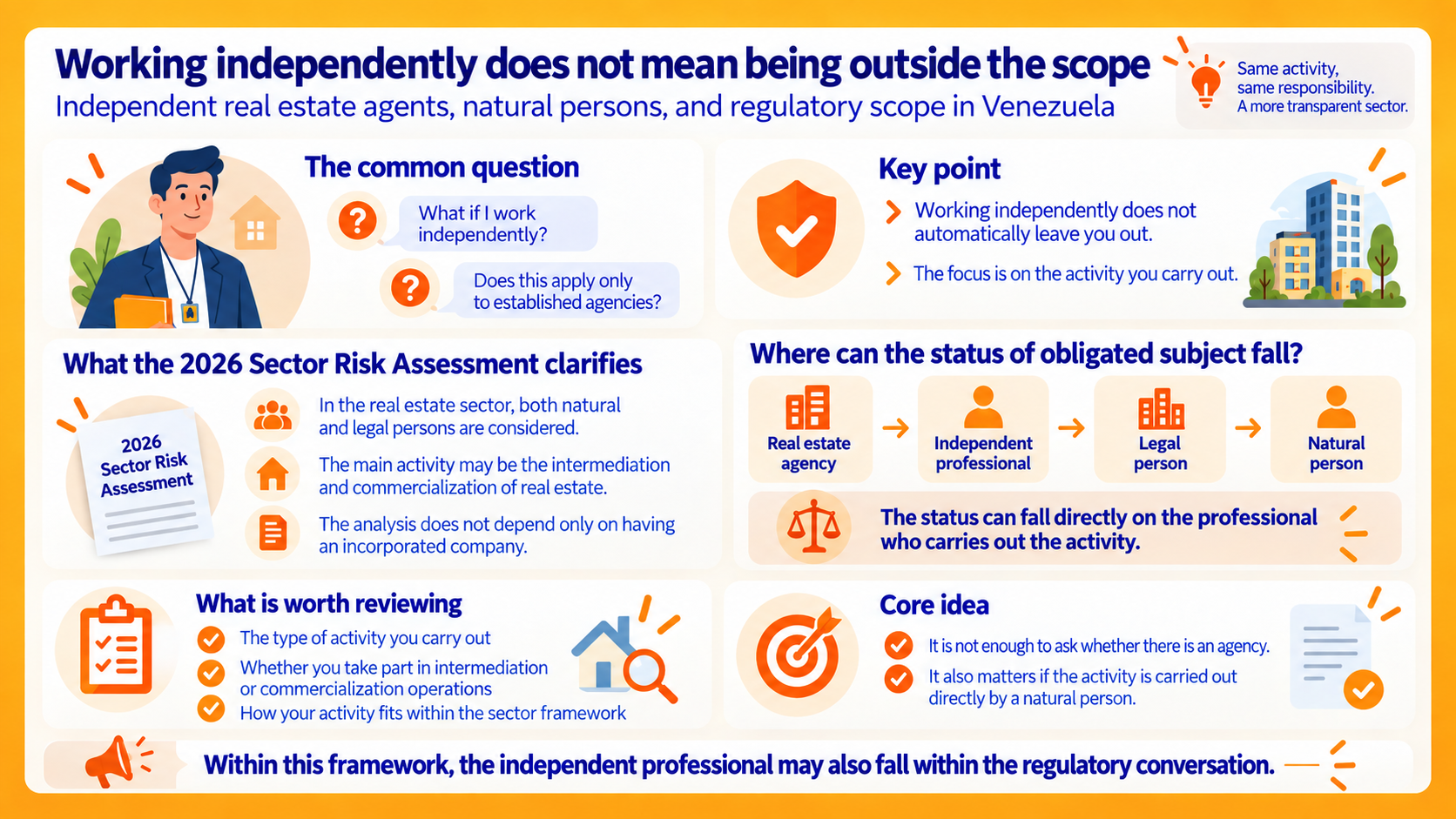
One of the questions that may arise after reading the Circular is what happens to a real estate agent who works independently and does not operate through an agency incorporated as a company. At this point, it is useful to look beyond the terminology used in the Circular and also consider the broader sectoral framework on which it relies.

The 2026 Sectoral Risk Assessment, prepared for lawyers, accountants, and real estate agents, explains that the real estate sector includes both individuals and legal entities whose main economic activity is the intermediation and commercialization of real estate.

The same document indicates that, in these professional activities, the status of obliged entity may apply directly to the professional carrying out the activity and does not necessarily depend on operating through a corporate structure.

This makes the position of independent agents particularly relevant. The fact that someone does not work through a commercial company or a real estate franchise does not, by itself, mean that they fall outside the obligations applicable to the sector.

What matters is how the activities the agent actually performs fit within the LOCDOFT and the provisions subsequently developed by ONCDOFT.

For that reason, an agent operating independently should review what role they perform in real estate transactions and how those activities fit within the applicable regulatory framework, rather than assuming that working as an individual automatically excludes them from the regime.

Registration does not end with filling out a form

Once it has been determined that registration is required, Circular 003-2026 distinguishes between the requirements applicable to different types of obliged entities.

For a legal entity, the Circular sets out a series of documents that must be submitted where applicable. That qualification matters, because it does not mean that every company must provide exactly the same set of documents.

For an agency incorporated as a legal entity, the Circular contemplates documentation related to its incorporation and legal representation, including its articles of incorporation registered with the Commercial Registry and any subsequent amendments, valid identification documents for legal representatives and members of the board of directors, the current RIF of shareholders and directors, and, where applicable, the power of attorney establishing legal representation.

Additional requirements also apply to companies incorporated abroad or to businesses that form part of groups controlled by a parent company.

Compliance officer or responsible person

If the organization has a compliance officer or person responsible for compliance, the Circular states that this person will be responsible for completing the registration and must provide, among other information, proof of identity, RIF, and documentation confirming their appointment to that role.

There is another point that should not be oversimplified: the Circular does not provide a separate list of documents for individual real estate agents in the same way that it does for lawyers and accountants practicing independently.

For that reason, it would not be appropriate to automatically apply to an independent real estate agent the requirements listed for those professions. The applicable documents should be reviewed according to the capacity in which the person is required to register and the information requested by the RUSO system itself.

System and platform

The process is completed through the Unified Registry of Obliged Entities (RUSO) system, where the requirements applicable to each case are submitted electronically. The Venezuelan Chamber of Real Estate has also informed professionals, offices, and franchises that registration is carried out through the ONCDOFT website using the RUSO platform, and that the process cannot be completed while information required by the system remains outstanding.

After the application is submitted, ONCDOFT must review and validate the information provided. The Circular also provides for the authority to verify information directly through databases maintained by other public agencies, helping avoid requests for documents that can already be confirmed through those sources.

If inconsistencies are identified during the review, or if documents are missing and cannot be verified directly by the authorities, the applicant must be notified and is given 10 business days from the date of notification to correct or provide the required information. Once the review is completed successfully, the corresponding certification is issued and the result is communicated by email.

RUSO certification is not designed as a document that must automatically be renewed every year. The Circular provides for indefinite validity as long as the registered information remains accurate. If information such as the registered address, contact details, ownership structure, board of directors, powers of attorney, or details of legal representatives changes, the registration must be updated within 30 consecutive days following the change.

Not every question has a simple answer

Circular 003-2026 has led to different interpretations within the real estate sector. Part of the confusion comes from the fact that one thing is what the document itself establishes, and another is how different organizations and professionals are explaining its application.

The Venezuelan Chamber of Real Estate, for example, informed professionals, offices, and franchises on September 12, 2026 that they should register their offices and real estate agents through RUSO. That is the guidance the industry association is currently communicating to its members.

At the same time, legal reviews examining the scope of the Circular have highlighted that, for real estate agencies, its application is linked to their involvement in the handling of funds associated with real estate purchase and sale transactions. This distinction helps explain why not every question can be answered by simply stating that anyone working in the sector is automatically subject to the same obligations.

Some points do appear more clearly in the documents reviewed:

  • There is a registration and updating process through the Unified Registry of Obliged Entities (RUSO).

  • The Venezuelan Chamber of Real Estate is communicating the registration requirement to real estate offices and agents.

  • The Circular establishes different requirements depending on the type of obliged entity and provides for the subsequent updating of registered information.

  • For those considered obliged entities, the framework also includes measures related to customer due diligence and the review of the source and destination of funds.

However, some questions may still depend on how a particular agency or professional actually carries out their activities. For example, determining whether a specific form of real estate intermediation falls within the circumstances covered by the regulations requires looking at the activity itself, rather than relying only on the commercial title used by the person or company performing it.

For that reason, this article does not seek to determine whether a particular real estate agency or agent is required to register. Our purpose is to gather and explain the available sources so that each professional can better understand what has been published and what aspects may need to be reviewed in their own case.

If there is uncertainty about how the Circular applies to a specific activity, the prudent approach is to verify the matter directly with ONCDOFT or seek advice from qualified legal counsel.

Disclaimer: The content of this article is provided strictly for informational and educational purposes. It does not constitute formal legal, tax, or financial advice. Real estate professionals and agencies should consult the applicable regulations through ONCDOFT’s official channels or seek guidance from a lawyer specializing in regulatory compliance.

Try 30 days free

Digitize your real estate operation from day one.

Start for free

Try ReliaHouse free for 30 days

Digitize your real estate operation and work with more control from day one.