

Back
Real estate prospect reviewing properties and tracking data via a digital platform.
Sales

What information should be recorded when a real estate lead comes in?

Which data to retain from the initial contact in order to maintain context, organize follow-up, and determine the next steps.

By ReliaHouse

9 min read
Last updated:

Identify the prospect and where they came from

Let's start with the simplest thing: being able to recognize the person when you come across their contact again.

Imagine that during the day you receive several messages. Someone reaches out through WhatsApp, another person comes from a real estate portal, and a third fills out a form on your website. At that moment, you probably remember who asked about what. A week later, with more conversations piled up, it may not be so easy.

That’s why it helps to save a few basic details from the very first contact: the prospect’s name, phone number or email address, the date they reached out, and, if several people work on the team, who is responsible for following up with them.

💡 There’s one more detail worth keeping: where that prospect came from.

Why save something that seems so obvious?

Because one thing is where you’re talking to the prospect, and another is how they originally found you. For example, someone may discover a property on a real estate portal and then continue the entire conversation through WhatsApp. If you only save “WhatsApp,” part of the context has already been lost.

There’s no need to overcomplicate it. When you return to that contact a few days later, you should be able to quickly answer two questions: who is this person, and where did they come from?
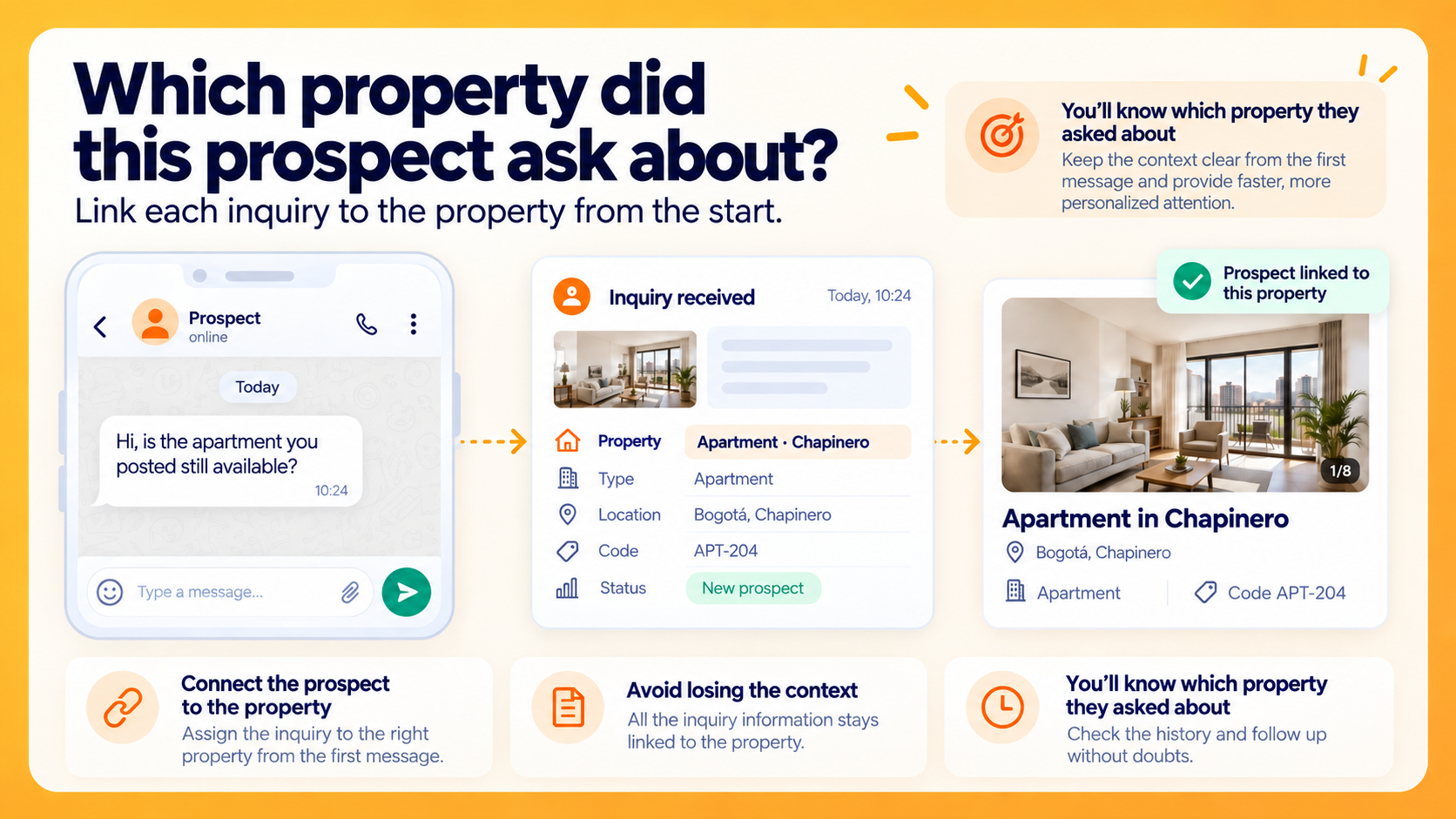
Which property brought this prospect to you?

Now imagine you open WhatsApp and find this message:

📱Hi, is the apartment you posted still available?

You know who sent it and start helping them. So far, so good. The problem may come a few days later, when you return to that contact and have to ask yourself another question: which apartment was it?

Number of properties

It may seem hard to lose track of something like that, but think about what happens when you have several properties listed and receive inquiries throughout the week. The prospect’s name alone doesn’t tell you the whole story.

That’s why, if someone first reached out about a specific property, it helps to keep that property linked to their contact from the beginning. It could be the internal property code, the listing link, or any other reference that lets you find it again without rebuilding the conversation message by message.

💡 And there’s one important detail: don’t erase that starting point just because their search changes later on.

Put it to the test

Let’s say Laura originally reached out about an apartment in Chapinero. You talk, she reviews the property details, and eventually decides she needs something more affordable in a different area. From that point on, you may show her other properties, but it’s still useful to know that the conversation started with that apartment.

Think of it this way: one thing is the property that brought the prospect to you, and another is the properties they begin considering afterward.

Keeping that distinction makes it much easier to return to the conversation days later and quickly understand how it started, even if the prospect’s search has already taken a different direction.

What are they really looking for?

Just because someone asks about an apartment doesn’t necessarily mean that apartment is exactly what they’re looking for.

Maybe they liked the area, the price is close to their budget, or it was simply the first listing that caught their attention. The conversation is what starts filling in the rest of the picture.

Let’s say a prospect reaches out about a two-bedroom apartment in Chapinero. As you talk, you discover they’re looking to rent, they need a parking space, their maximum budget is $3,000,000, and they’d prefer to move within the next month.

🧠 Now you know much more than you did at the beginning.

That’s why it helps to keep track of the details that are actually shaping their search.

You don’t have to learn everything in the first conversation

Some preferences only become clear later. Maybe at first they say they’re looking in Laureles, but after reviewing a few options, they’re also willing to consider El Poblado. Or perhaps the balcony that originally seemed optional turns out to be something they really care about.

When that happens, update the information.

The goal isn’t to fill out a profile just for the sake of completing a list. It’s to make sure that when you speak with that prospect again or want to find another property for them, you don’t have to ask: what exactly were you looking for again?

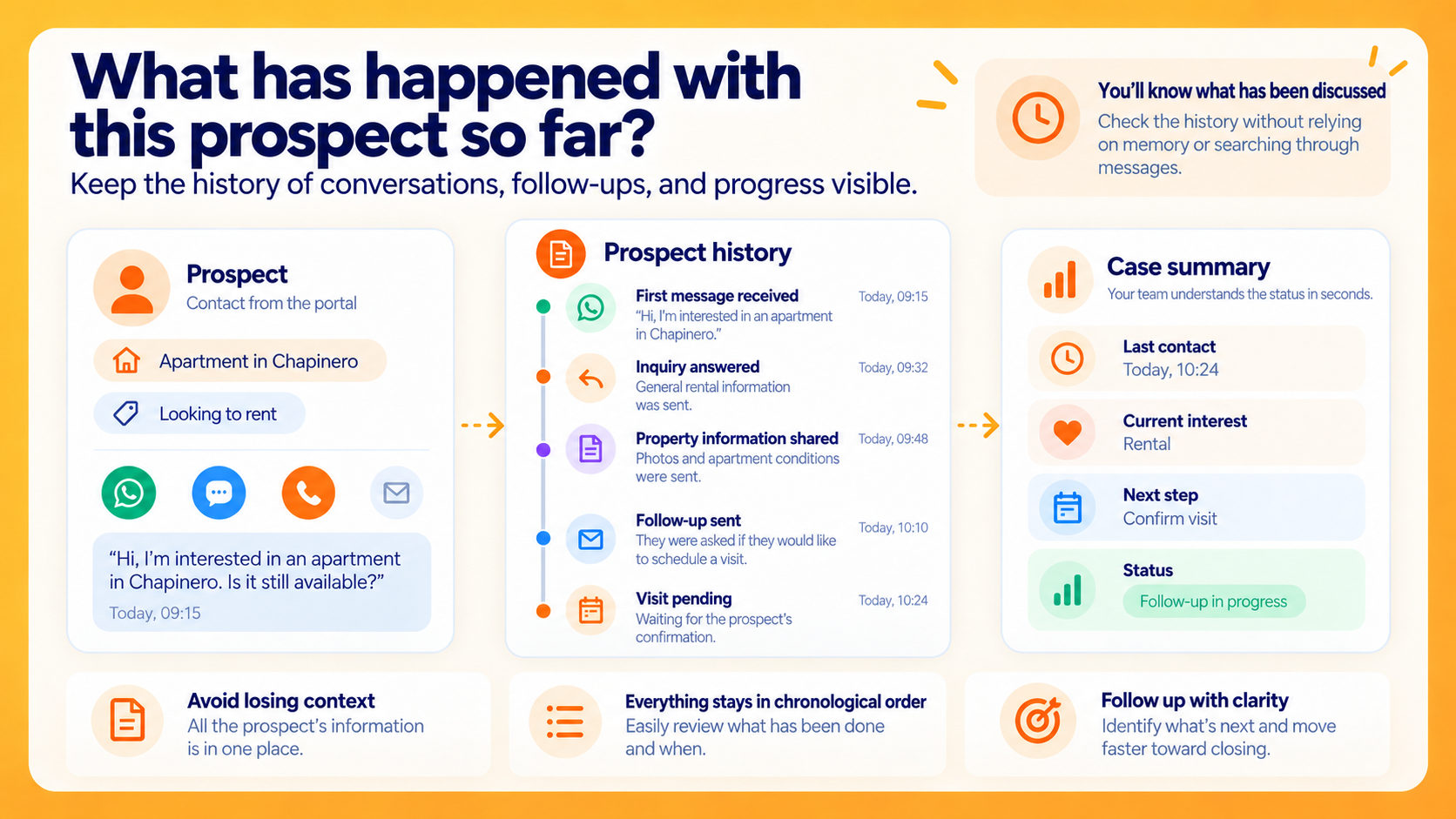
What has happened with this prospect so far?

You already know who the prospect is, which property brought them to you, and what they’re looking for. Now comes another question that seems easy until you try to answer it a few days later: what have we talked about with this person so far?

Imagine you reach out to Andrés again after a week. You remember that he was looking for an apartment to rent, but you’re not sure whether you already sent him the options in Laureles, whether he ruled any of them out, or whether you had agreed to schedule a viewing.

You could go back to WhatsApp and start scrolling through messages until you find the answer. It works, of course. But the more conversations you handle, the less practical that becomes.

💡 This is where it helps to keep a small record of what has happened so far.

Strategic context

You don’t need to copy every message or write a summary after every hello. It’s enough to keep track of the things that change or move the conversation forward: what information you sent, which properties you reviewed, which one they ruled out, what questions came up, or whether there has already been a call or a viewing.

For example:

🗒️ Three apartments in Laureles were sent. He ruled out two because they didn’t have parking and asked to schedule a viewing for the third.

With a note like that, you can pick up the conversation again without having to reconstruct the entire story.

And if more than one agent works at the real estate agency, this becomes even more useful. The idea is simple: someone else should be able to open the record and understand what has happened up to that point, without having to ask the colleague who handled the prospect first or review entire conversations.

The goal isn’t to document everything. It’s to save enough context so you don’t lose the thread.

What stage is this prospect at?

By this point, you already have quite a bit of context: you know who the prospect is, which property caught their attention, what they’re looking for, and what has happened in previous conversations.

But something is still missing.

Imagine you open their record and find several notes, properties you’ve sent, and even a call from last week. You read through everything and still have to ask yourself: Okay... so where did we leave things?

💡 To avoid that, it helps to make it clear what stage the prospect is currently at.

It can be as simple as indicating that they’ve just come in, have already been contacted, are reviewing a few options, or have a viewing pending. If they’ve decided to pause their search for now, that’s worth making clear too.

How should I organize it?

There isn’t one list of statuses that works for every real estate agency. One team might use New, Contacted, Viewing scheduled, and Follow-up, while another may need to divide its process differently.

What matters is that the names make sense to the people who will actually use them.

Try a simple test: if another agent opens that prospect’s record without asking you anything, can they quickly understand where the conversation left off?

If the answer is yes, the status is doing its job.

What needs to happen next?

Knowing that a prospect is being followed up with helps, but it still leaves one question unanswered: what needs to happen next?

Let’s go back to an example.

Camila is looking for an apartment to rent. You’ve already spoken, you sent her a few options, and you know she’s still interested. If you open her record a week later and the only thing you see is Follow-up, you’ll probably have to go back through the conversation to remember what was left pending.

Now imagine that, instead, you also find this:

🗒️ Send new options on Thursday. Looking for two bedrooms and parking in Laureles.

The difference may seem small, but now you no longer have to guess what the next move is.

Status and action

Maybe you need to confirm with the owner whether the property is still available, send other options, call the prospect, schedule a viewing, or simply follow up on a date you already agreed on.

And there’s one thing worth keeping separate: the status tells you where the prospect is; the next action tells you what you need to do with them.

A prospect can be in follow-up, but that doesn’t tell you whether you should call tomorrow or wait two weeks. So whenever something is pending, try to leave a clear next action and, when it makes sense, a date for it.

You don’t need to turn every conversation into an agenda full of tasks. If the prospect told you they’ll reach out when they’re ready to continue the search, there may be nothing you need to do right away.

The idea is much simpler: when you open that contact again, you should be able to see what comes next without having to reconstruct the entire conversation.

Have we spoken with this person before?

So far, we’ve followed a fairly straightforward conversation: a prospect comes in, we know which property they asked about, we understand their search better, and we keep track of what happens along the way.

But in practice, things don’t always happen that neatly.

Imagine someone asks about a property through a real estate portal. You save their details and start helping them. A few days later, that same person finds the agency’s website and reaches out directly through WhatsApp.

If no one realizes they were already in your records, you now have two prospects who are actually the same person.

And it can get even more confusing. One record might contain the property they originally asked about, while the other has the latest conversations and the new areas they’re considering.

💡 Before creating a new contact, it’s worth doing a quick check: have we spoken with this person before?

Their phone number and email address can help you recognize them when those details are available. If you find that they already exist, it usually makes more sense to keep updating the same record instead of starting a new story from scratch.

Because, in the end, keeping information about a prospect isn’t about filling in fields just for the sake of it. It’s about making sure that when you speak with that person again tomorrow or two weeks from now, you can quickly understand who they are, what they’re looking for, what has happened, and what needs to happen next.

Try 30 days free

Digitize your real estate operation from day one.

Start for free

Tags

Try ReliaHouse free for 30 days

Digitize your real estate operation and work with more control from day one.