

Back
Reviewing the Certificate of Tradition and Freedom before listing a property in Colombia
Due diligence

Before acquiring a property in Colombia: what to check in its Certificate of Tradition and Freedom.

This document reveals key information about the property.

By ReliaHouse

6 min read
Last updated:

What is it and how can I identify it?

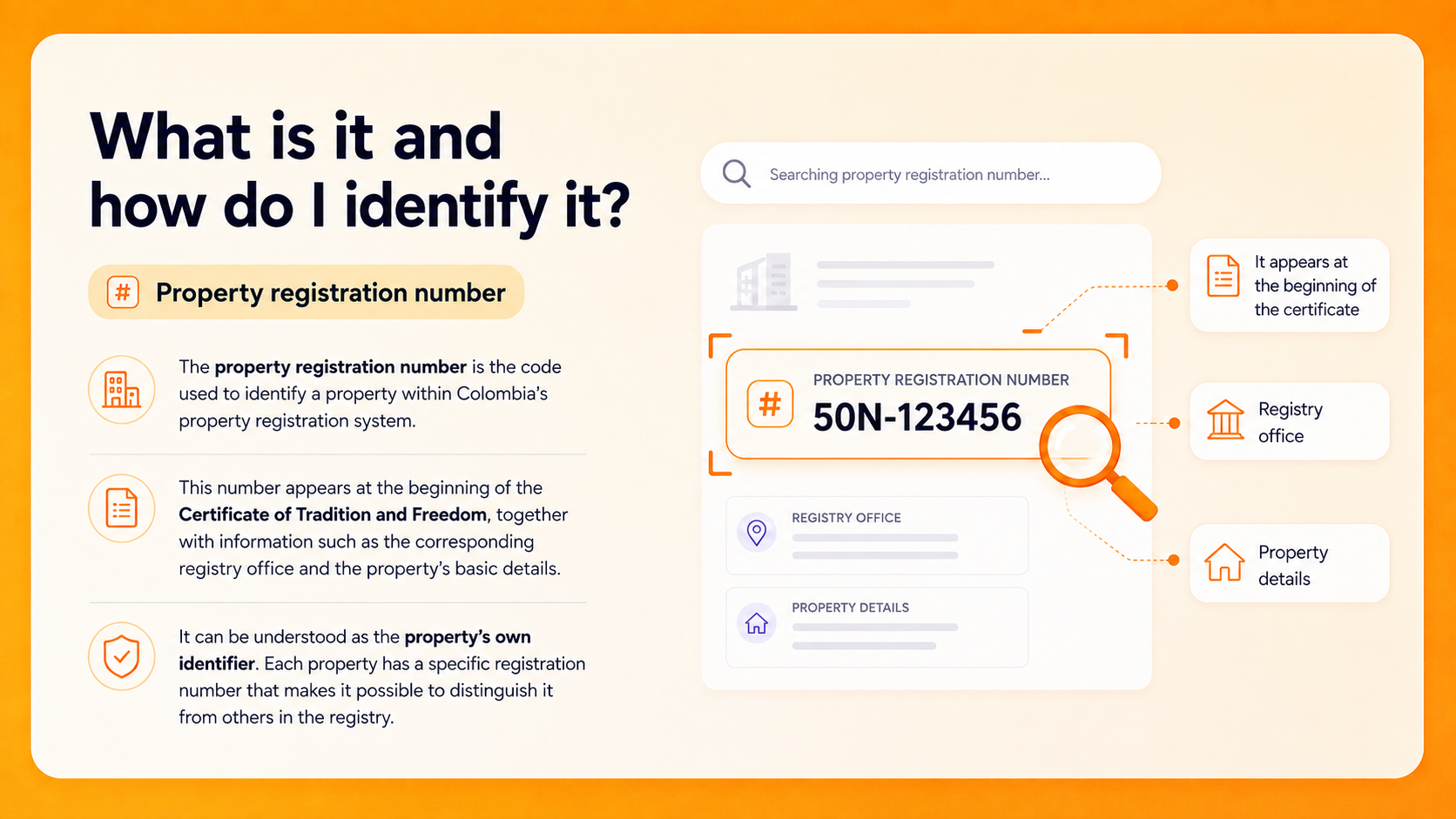
The real estate registration number is the unique code used to identify a property within Colombia’s property registration system. You can find it near the beginning of the Certificate of Tradition and Freedom, together with information such as the corresponding registry office and the property’s basic details.

It can be understood as the property’s own registration identifier. Each property has a specific registration number that distinguishes it from all others in the registry.

How is it structured?

The code includes an identifier associated with the Public Instruments Registry Office or registration district responsible for that property record. For example, in a registration number such as 040-628801, the code 040 corresponds to the Barranquilla registration district.

The remaining digits identify the individual property record within that registry office.
How can you verify whether a property registration number exists?

One of the easiest ways is to check it through the official portal of Colombia’s Superintendence of Notaries and Registration.

Once there, select the Public Instruments Registry Office that corresponds to the property and enter the registration number shown on the certificate.

If the platform recognizes the registration number and allows you to continue with the request, it means that the number is registered with that office and corresponds to an existing property record.
Review how the property record is listed

In many cases, the property record will appear as active, which means it is still current within the registration system. It may also appear as closed when, for a registral reason, that record is no longer in use and the property information has been transferred to another registration number or has undergone a change.

💡 A closed property record does not automatically mean there is a problem with the property.

If a record appears as closed, the important thing is to understand why it was closed and review the certificate’s annotations to determine what happened and, when applicable, which registration number now contains the property’s current information.

Before continuing with your review, make sure the status of the property record is consistent with the information you are checking and pay attention to any references to another real estate registration number.

Order of the annotations

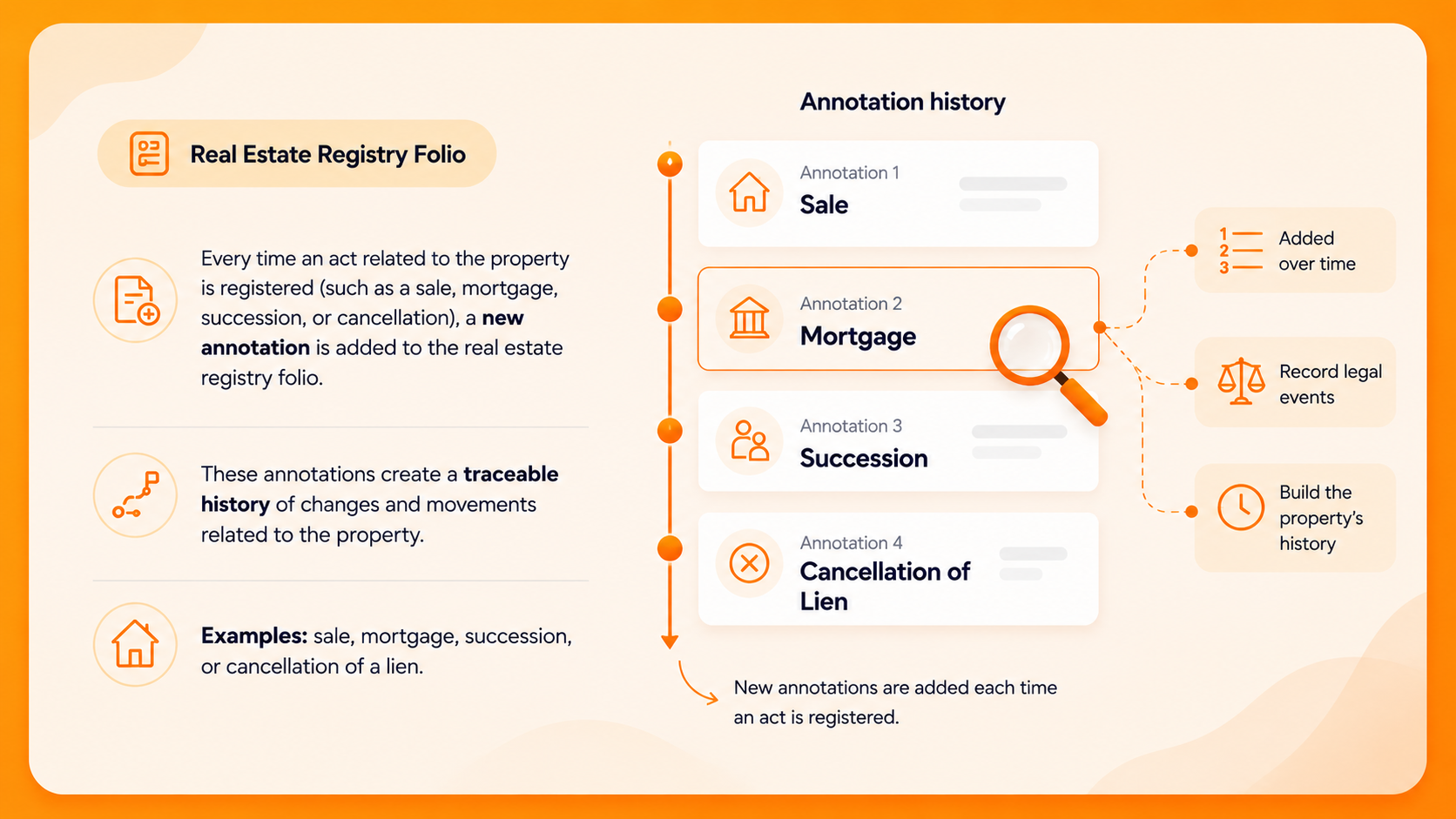
Each time a legal act related to the property is registered — such as a sale, mortgage, inheritance, or the cancellation of an encumbrance — a new annotation is added to the property’s registration record.

Chronology

The annotations are presented in chronological order, so each registered act involving the property is added as a new entry in the property record.

The annotations are numbered consecutively. The first ones correspond to older events, while those with higher numbers reflect acts that were registered later.

Find the current owner

To identify who is currently listed as the property owner, you do not need to read the entire certificate from the beginning. The most practical approach is to start with the most recent annotations and follow a simple sequence to locate the latest registered transfer of ownership.

  1. Review the most recent annotations

  2. Find the latest transfer of ownership

  3. Identify the buyer or recipient

👁️‍🗨️ Within that annotation, check who appears under: FROM: the person transferring the property. TO: the person acquiring the property.

The person listed under TO: in the latest valid transfer of ownership is, in principle, the person currently registered as the property owner.

Review what appears afterward

Identifying who is listed as the owner is only one part of the review. You should also examine any subsequent annotations to determine whether there are records that could affect the property or the transaction you are evaluating.

Pay particular attention to:

  • Encumbrances: check for mortgages or other registered obligations affecting the property.

  • Precautionary measures: look for annotations such as attachments, civil claims, or court-ordered restrictions.

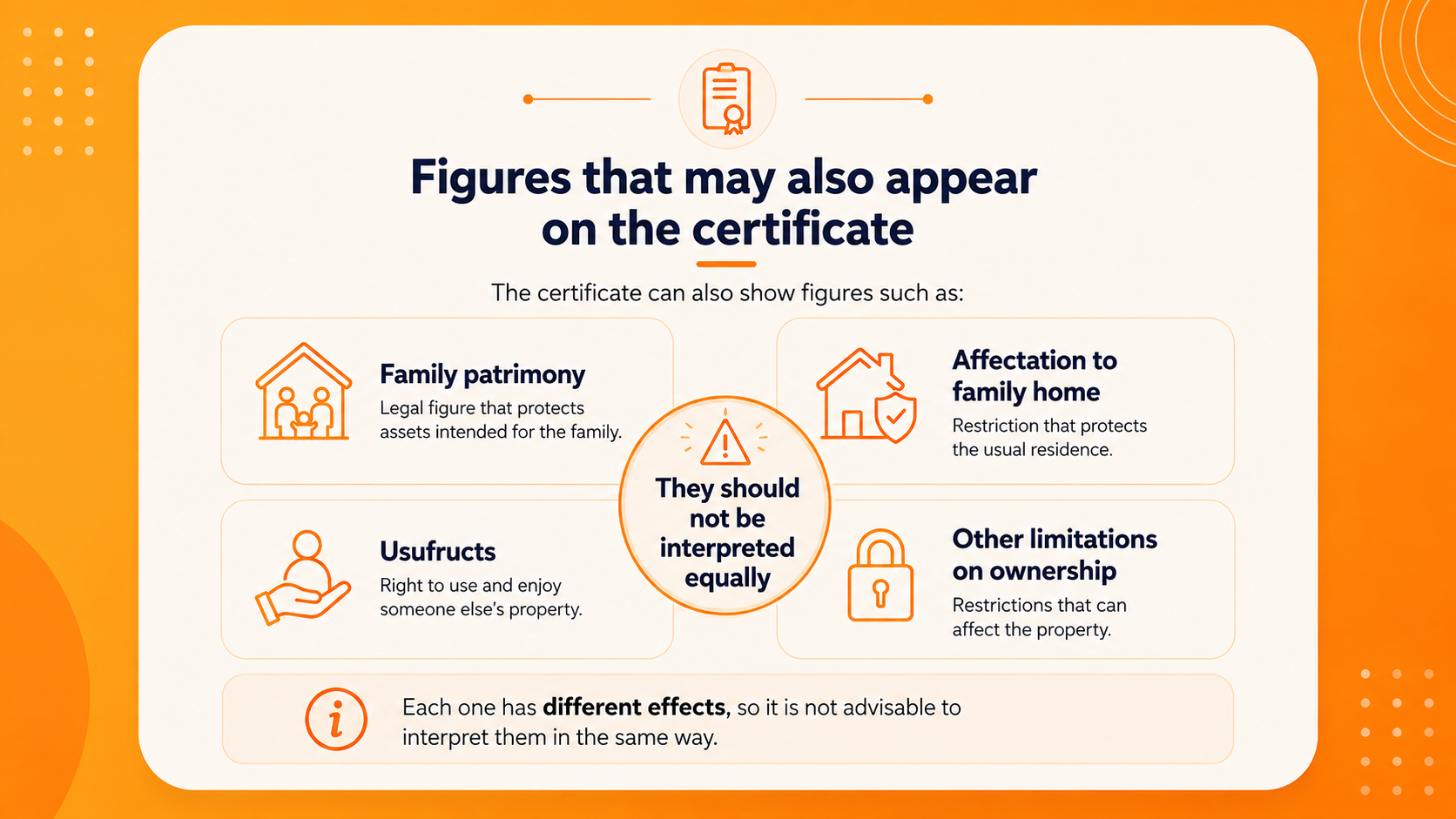
  • Restrictions or legal protections: verify whether the record includes family patrimony, family home protection, usufruct rights, or other restrictions.

  • Ownership percentage: confirm whether the person acquired 100% of the ownership rights or only a partial interest in the property.

  • Owner information: compare the registered name and identification number with those of the person involved in the transaction.

When the Certificate is not enough

Reviewing the Certificate of Tradition and Freedom does not always resolve every question involved in a property transaction.

If you find annotations that are difficult to interpret, inconsistencies between the people involved in the transaction and those listed in the registry, court-ordered measures, inheritance proceedings, usufruct rights, or other unusual situations, it is advisable to stop and investigate further before moving forward.

📝 Review deeds, court decisions, supporting documents, or consider a title study with the assistance of a qualified legal professional.

Pay special attention

Finding any of the following does not automatically mean there is a problem with the property. It means the available information deserves a closer review before you continue:

  • Annotations whose scope is unclear or that are difficult to connect with later entries.
  • Attachments, precautionary measures, or other court-related actions registered against the property.
  • Inheritance proceedings, adjudications, or transfers that require additional documents to understand how ownership rights were acquired.
  • Usufruct rights, family home protection, or family patrimony, as these may impose specific restrictions on the property.
  • Differences between the person offering the property and the person listed in the registry as the registered owner.
  • Closed property records or references to other real estate registration numbers, especially when you need to trace the property history into another record.
  • Cancellations that are difficult to link to earlier annotations or situations where it is not clear whether an encumbrance or restriction is still in effect.

Reviewing the Certificate of Tradition and Freedom can help identify these warning signs, but it does not replace a legal analysis when the property’s registration history requires a more detailed interpretation.

Try 30 days free

Digitize your real estate operation from day one.

Start for free

Try ReliaHouse free for 30 days

Digitize your real estate operation and work with more control from day one.